Trip Forman: Welcome to the REAL Board Loft. I’m Trip Forman. Today we’ve got Jake Sacks with us. Jake, welcome.
Jake Sacks: Thank you.
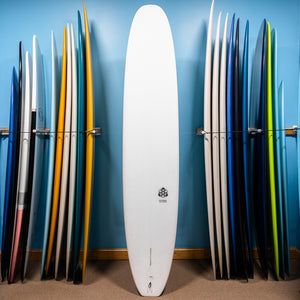
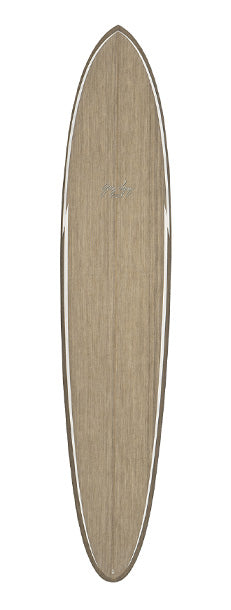
Trip Forman: We are reviewing the Gerry Lopez Gliders produced by Surftech in their Tuflite-NFT construction, which is an EPS epoxy flax cloth construction. Kind of an environmentally friendly construction. These boards are sick.
Jake Sacks: They are sick. They are super fun.
Trip Forman: I’ve been personally surfing these things since about mid-August last year, so almost coming up on a year. Jake’s got the 9’6”, I’ve got the 10’6”. Let’s start out by reading some dimensions. The 10’6” is 10’6” x 23 3/4” x 3 3/8”, 95 liters, and it is a single fin. Jake, what are the dimensions on the 9’6”?
Jake Sacks: The 9’6” is 23” wide by 3 1/4”, and it’s 81.5 liters. Single fin as well.
Trip Forman: That board makes you look small. It makes you look like you’re 5’2”. Let’s get into how these boards surf, who they’re good for, and what they do because gliders are often misunderstood. Nobody knows what a glider is. At first they’re like, “Is that a stand-up paddleboard?” Then the next thing is, “Is that a gun?” They just don’t understand what it is.
I think the easiest way to describe a glider is to say it’s as long as a longboard, or obviously longer, but then you lean it out and race it out so it’s a lot faster. Then you get rid of all the things that most longboarders never use. Most longboarders don’t nose ride. A lot of people ride longboards because of the wave-catching ability, the wave count, the ease, and the range. Obviously good nose riders rip on nose-riding boards, but a lot of people with longboards never even get on the nose.
What the glider does is take that longer length with very fast paddling and very fast down-the-line speed, but trims all the fat that you don’t use. That being the nose and the width of the board. These are narrower than what they would be if they were nose riders, and it makes the board noticeably faster through the water, both paddling and down the line.
Jake Sacks: I noticed that immediately when I jumped on it, just how fast it was on the wave. The nose didn’t catch. Water releases off the rails and it just goes. Even paddling it, you feel like a hero because it’s got so much volume. A lot of longboards don’t paddle that well sometimes. They kind of plow the water out of the way.
Trip Forman: Exactly. This thing was like a bullet. Very refined surf equipment. Long and lean, whether it be a 5’8” or a 10’6”. If you’re long and lean like that, that hull shape goes through the water with less resistance than short and fat for the same amount of volume.
I want to talk a little bit about the accessibility of these boards because with some of my gliders that I’m absolutely in love with, I’ve told people, “You’ve got to try this.” They try it and the very first session isn’t a hero session, then they’re like, “I’m out. This isn’t for me.” Some gliders can feel like an 80-liter board when they’re actually 110 liters, or if you don’t know how to surf them they can feel impossible because they suddenly get a mind of their own and start going in a direction you never predicted.
The first time I loaned one of these out was to my buddy Seth Corbin from New York, who’s basically my size, but he’s a shortboard surfer. He doesn’t even have a longboard in his quiver. He got on the 9’6” and on his very first wave he was riding it like he’d surfed it for years.
Jake Sacks: Nice.
Trip Forman: It was really easy to get on and ride without it feeling quirky or unpredictable. Then he started doing pumps, wraps back into the pocket, taking off late. He was surfing the thing really well for somebody who doesn’t longboard and had never ridden a glider in his life. Having had the opposite experience with some other boards I’ve loaned out, I thought that was really cool.
Jake Sacks: These definitely paddle really well. I would put these, length for length, at the top of the glider category as far as how well they paddle. That 9’6” easily paddles like a foot longer than any other board I’ve surfed. It out-paddles my 10’6” big-wave guns and my 10’6” gliders.
I think a lot of that has to do with the shape Gerry put into it. It’s pretty wide-point forward. It almost looks like an old-school Makaha gun more than what a lot of gliders out there look like. Having that width and thickness forward under your chest, the thing just hammers when you’re paddling and catching waves.
They also don’t have a whole lot of belly in them either, which helps. It doesn’t push water. It’s a pretty flat entry rocker, then it goes into V through the middle with some slight concave, but mostly V all the way through the tail. A lot of gliders have really strong belly, and Gerry opted not to do that. The rail is tucked in on the bottom as well. It just sheds water really well.
I think this construction helps it paddle well too. It’s nice and floaty, but it still has some weight to it. It doesn’t feel corky or weird in the water at all for how long it is.
Trip Forman: Let’s touch on the construction because when you say Surftech and epoxy, everybody flashes back to Tuflite. It’s important to point out that these boards are not made in Tuflite construction. Tuflite is awesome for dropping your board in the parking lot or slamming it into your garage door. Great for rough-and-tumble ding abuse.
There are people who are pro or against it in terms of performance, but these boards are not Tuflite. This construction is completely different. It’s a stringered EPS core with epoxy resin and flax cloth. It’s much more made and weighted like a PU/poly board but with more durability, longer lifespan, more ding resistance, and more breakage resistance.
Jake Sacks: Another thing that really shocked me when you handed me this board was how small the fin was for such a large board. How do we fin these things?
Trip Forman: I always go small on fins in gliders. Every glider I have uses a much smaller fin than you’d think. I’ve even heard people say the fin is really just keeping the tail behind the nose. The board didn’t spin at all. It locked right in.
On the 9’6”, we’re using a 7.5” FCS Christenson single fin. On the 10’6”, I’m riding an 8” version of the same fin. They work great. You don’t need more fin. The board feels really balanced.
When you put too big a fin in any glider, the board stops feeling neutral. You’ve got this really long board that you’re trying to drift and conform into the curve of the wave, and it doesn’t want to do it.
Once you get the right size fin and the board feels neutral, it’ll drift into the curve of the wave and just go. It doesn’t feel like an anchor at all.
That small day you and I surfed on the south side, I gave you the 9’6” and grabbed the 10’6”. I thought I grabbed the 8” fin out of my truck, but I accidentally grabbed a 9”. I still had a really good time, but the board was noticeably harder to surf. I remember thinking maybe it was just a really good 9’6” wave and not a good 10’6” wave.
What it ended up being was the wrong fin. The board felt a little critical and stiff. It didn’t want to fit into the wave as well. A 9” fin on a 10’6” board sounds totally normal, but you’ve got to go small on these. Seven and a half and eight-inch fins are the sweet spot.
Let’s cover the range of what these boards are good for. You can literally ride them in almost anything except chunky death shorebreak because then they suddenly feel 16 feet long.
Jake Sacks: Any waves from tiny surf all the way up to second-bar or third-bar waves a mile offshore, they work really well. Prior to using them, I expected to use the 9’6” and 10’6” equally, but because the 9’6” paddles and catches waves so well, I ended up using it more for the entire range.
I never really needed the 10’6” from a big-wave perspective. On really far outside bars where I’d normally ride something that big, I just ride the 9’6” because it paddles so well.
Where the 10’6” stands out is on waves that break, then unbreak, then reform down the line. This thing just keeps going and going. There are a lot of places with small waves that connect forever, like point breaks or long-running reefs, where you can connect sections all the way to town.
If you’re surfing really facey waves like South Shore Hawaii, Old Man’s in California, or spots like that, then the longer one is definitely in play.
I had an absolute riot surfing the 9’6” every day during that run of swell we had last September. Just absolute magic sessions. It didn’t hold you back at all being a glider.
Especially after we’d had no waves for five months and then the entire world came to Cape Hatteras, it was nice to sit on that thing and just rack up waves and laps.
I can’t say enough good things about both of them.
Trip Forman: You have to have a glider in your quiver. It’s too much fun. It turns sessions where you wouldn’t surf any of your other boards into really fun sessions. You get into waves so early that you make waves you wouldn’t make on your other boards.
It’s like the next dimension. Zach calls it being enlightened. Once you’ve seen the light of the glider, you’re enlightened.
Jake Sacks: I’ve seen you guys add them to your quiver and then suddenly you can always surf no matter what.
Trip Forman: Exactly. They’re fast. That’s the thing people don’t understand. Compared to gliders, you go back to a traditional nose rider and it feels like you’re dragging a bucket behind the board.
During those hurricane swells, it was nuts because you had these super long-period outside waves where you wanted a big board just to get out there. Some of those waves were a mile offshore. But once you were on the wave, the board never felt big because you had so much canvas to work with. Super fun.
Obviously, be enlightened too.
Jake Sacks: I’m enlightened.
Trip Forman: Anyway, our Philly is done. These are the Gerry Lopez Gliders and they are awesome. If you have any questions about them or would like to order one, you can always reach us at the shop, 252-987-6000, or look us up online at realwatersports.com. We are here to enlighten you. Thanks for tuning in.



 REAL Review