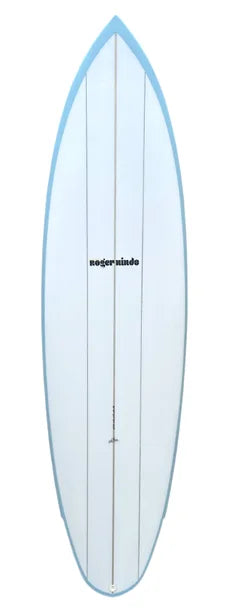
Trip Forman: Welcome to the REAL Board Loft. I'm Trip Forman. We are here today to talk with you about a board from Roger Hinds, and it is the Roger Hinds Master. This is a board that Roger shaped after a very influential trip with Mickey Munoz to Scorpion Bay. Those guys were hanging out down there, and between Roger Hinds and Mickey Munoz, there is a massive amount of shaping history, shaping experience, and Mickey's openness to alternative craft to maximize every session. There was a lot of free thinking and open design talk going on. One of Mickey's quotes that will always stick with me basically forever is that "there are no bad waves, there is only poor choice in equipment." That's a lifelong quote that everybody should remember. What was passed to Roger in that conversation is that if you're looking to extend your surfing fun and extend your surfing experience later on in life—of which both of those guys are absolute masters at extending their surfing beyond when most people would be surfing age-wise—one bit of advice that Mickey passed on is to make the board wider. In that conversation, they were talking about whether going wider is going to slow the board down rail-to-rail, and what to do with the design of the board if you are going to make it wider to adapt that width so it isn't a negative. The very first thing Mickey fired back was that all standup paddleboards are 28, 30, 32, or 34 inches wide, so why can't we start making surfboard designs above 23 inches wide and adapt them to normal surfing without a paddle? That is the basis for the Roger Hinds Master: added width to give you more stability and more planing surface, combined with a shape that negates the width so you can still perform on the board.
One of the things Roger is really known for is pulling down the rails, because every board Roger makes is hand-shaped rather than shaped by a computer CNC machine. He is able to manually pull down the rails so that regardless of how thick the board is in the middle, the rail stays thin. For example, this 7'2" that I surfed is 7'2" x 23.5" x 3.5". When you hold this board under your arm and feel the rail, it feels like the pulled-down rail of a 2.75" board, so it doesn't carry a lot of volume on the rails. He also puts a good amount of V in the board—a double concave to V—so that the board rocks back and forth easily to initiate turns. Having no excess volume in the rail definitely helps with burying and holding the rail in the water through the turn.
I rode this 7'2" here in the Outer Banks in Cape Hatteras, and then I also took it to California and rode it at Rincon on a point break. I would definitely say this board is incredibly easy to surf. It gives you a lot of paddle confidence in terms of stability while paddling and speed through the water. You could literally bobble your takeoff two to three times without falling off, still make the wave, and continue to do turns and cruise down the line. I surfed this during a really good run of waves early in the morning when I was way too stiff after surfing a bunch of days in a row. On any other board, I would have fallen off three times, but you literally could not fall off this board. It was really reassuring, and the paddle speed and ease of getting into waves made it a huge confidence builder. I was riding it as a thruster, but you can also ride it as a quad. Roger rides his own personal Masters as a thruster as well.
In the smaller sizes like the 7'0"s and 8'0"s, the added width gives you more stability and more glide through flat spots compared to other boards. However, it still has tail rocker, a narrow nose, and the ability to turn when you want it to, giving you a reassuring, easy, but high-performance ride.
When looking at the bigger sizes, a lot of surfers riding 9'6" or 10'0" longboards don't necessarily need to be riding longboards. Most surfers ride them for paddle ability and wave count, not because they want to nose ride—in fact, about 80% of them never go to the nose. By narrowing the nose and adding more rocker, you eliminate the wind resistance and water-pushing effects of a wide nose with concave. On the bigger Masters, like this 9'0" x 24" x 3.75", Roger uses his gun rocker. Riding it as a thruster lets you get into waves much earlier than a longboard, while giving you the ability to do S-turns down the face, nice faded bottom turns, and clean lines down the wave without catching the nose or getting catapulted on late drops.
Even at 3.75" thick—which is well into big wave gun territory—the rails are heavily pulled down and foiled to feel like a 2.75" or 2.875" rail. It features a 5-fin setup with nose and tail rocker. For surfers getting along in years who want a board to catch waves early and continue their surfing journey, this is an insane option. I have a 9'0" that I've been surfing around here on high-tide days, and it offers far more maneuverability and allows for more aggressive, committed turns than a 9'0" mini glider or traditional longboard.
The extra width handles everything from slopy waves to vertical faces, mid-to-high tide beach breaks, and point breaks like Rincon. The only drawback to the extra width is in super hollow, pitchy, or sucked-out surf, but surfers looking at this model generally aren't targeting those types of waves anyway. In fun-focused waves, the extra width combined with the V bottom and thinned-out rails makes it an incredibly easy, enjoyable board to surf.
That is the Roger Hinds Master. If you have any questions or would like to order one stock or custom, reach out to us at the shop at 252-987-6000 or visit us online at realwatersports.com/surfing. Thanks for tuning in.