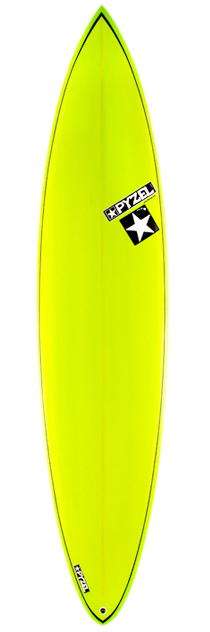
Trip Forman: Welcome to the REAL Board Loft. I’m Trip Forman, and this is the Pyzel Padillac. We’re going to start with a little Gun 101 and talk about why this board is designed the way it is and how it differs from your standard shortboard.
When you get into bigger, more powerful waves, the name of the game is still catching waves, but instead of you and your board creating speed through pumping and lift, the wave already has all the power you need. In bigger surf, you want the board to be more neutral in the water so it’s not lifting you up. The wave provides the speed, so you don’t need to generate it yourself.
Looking at this board compared to a normal shortboard, the first thing you’ll notice is more width and thickness forward. On a standard shortboard, most of the foam is under your feet because that’s where you’re standing. On this board, the foam is moved forward because that’s where your chest is when paddling. That’s a major difference, and it’s where the name Padillac comes from—you want a board that paddles significantly better to get you into waves and help you navigate the lineup.
There’s a lot of foam carried into the nose, which you can see in the foil. It gives the board excellent paddling speed, especially in open water where you’re further outside and need to cover more ground. Whether you’re chasing a set or getting out of the way of one, that extra paddle power makes a huge difference.
On the tail end, the board is much narrower than a typical shortboard or hybrid. A wider tail creates more lift and speed, but in bigger waves you don’t want extra lift pushing you out of the water. You want control and stability, so the Padillac uses a pin tail to keep the board settled and more neutral at speed.
A common question is why the board has two leash plugs. It distributes the load across both plugs, reducing the chance of one ripping out in heavy surf. If one does fail, you’re still connected to the board, which can save it from ending up on rocks or a reef. You rig it by attaching a leash string to each plug and running the rail saver through both.
With a narrow tail like this, you don’t want to oversize your fins. Fin size is based on your weight but also the tail width. Bigger fins create more lift, and in a narrow tail that can throw things out of balance. At higher speeds, you also don’t need as much fin to generate lift, so downsizing can actually improve performance. I rode this board as a quad with slightly smaller fins and really liked it both frontside and backside.
I just got back from a trip to Puerto Rico where we had double to triple overhead surf, and this board performed incredibly well. The paddling advantage was obvious right away, but what really stood out was the ability to control speed and still push hard turns at high speeds. On some waves, I was clocking over 28 miles per hour and could still lay into turns confidently, which is not something you get on more lifty boards.
The board also paddles significantly faster than smaller boards when you’re sitting far outside. It helps you track down peaks, deal with current, and get into faster-moving waves. Construction-wise, these boards are built more durable with heavier glassing and a stronger stringer. That extra weight actually helps in big surf by keeping the board planted instead of lifting off the water at speed.
Overall, from paddling to durability to control, this board is built for serious waves. It’s available from 6’10” up to 9’0”, and don’t be afraid to size up. The biggest mistake in big surf is going too small and not having enough board to get into waves. The goal is to have enough paddle power to catch waves and a neutral feel so you can really push your surfing once you’re up and riding.
This is the Pyzel Padillac. Check it out on our website at REAL Watersports or give us a call at the shop. Thanks for tuning in.


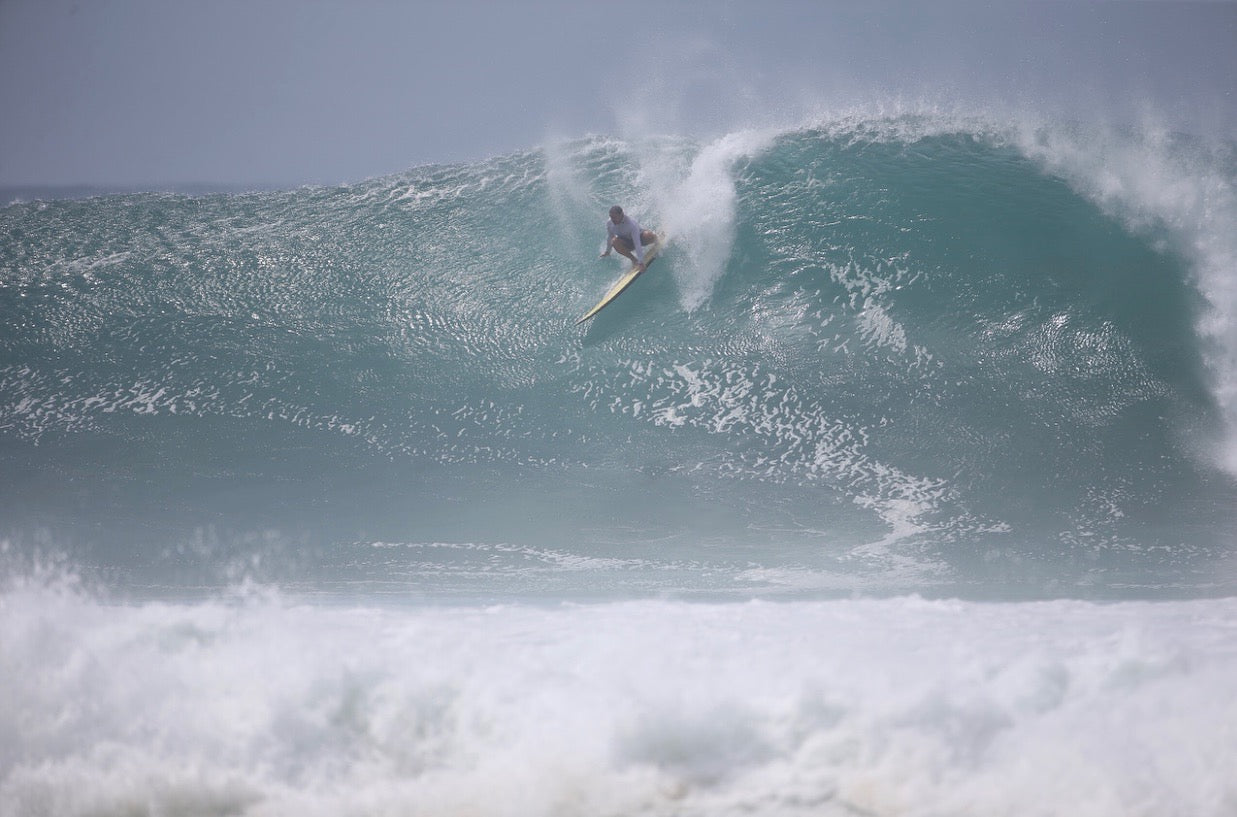 Trip Forman | Pyzel Padillac | 📷 Chad Oakley