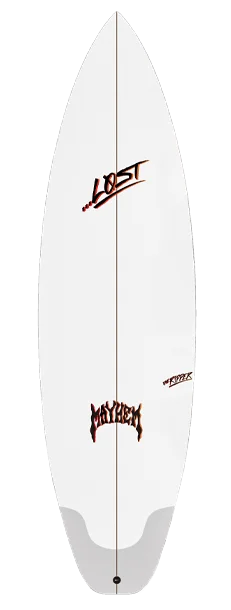
Trip Forman: Welcome to the REAL Board Loft. I’m Trip Forman, and we’ve got Dawson with us. Dawson, welcome. We want to talk with everyone about the Lost Ripper. The Lost Ripper is a board Lost released following up on their hugely successful Rad Ripper. They wanted to take some of the retro elements out—like the beak nose and the wing in the back—and turn it into more of a smooth bump wing, giving it more of a performance edge while keeping generous dimensions and a flatter, friendlier rocker. It’s very easy to surf and can be surfed at a high level across a wide range of abilities. It’s kind of the latest evolution of that Baby Buggy lineage, one of our favorite Lost shortboards, and it’s been amazing to see how many people are stoked on it. Dawson was especially fired up to get one of these in the water—he kept texting me about it—so Dawson, talk about why you like it.
Mark Dawson: Yeah, so this board is 5’6”, 19 1/4”, 2 3/8” thick, about 27.5 liters. I like it because it’s not super rockered out—it’s more of a medium rocker. Around here, if it’s not overhead, you can ride it in waist- to head-high waves. I’ve been running large fins in the smaller, mushier surf and switching to mediums when there’s more push. This has been my everyday board—I ride it in everything. It gets barreled, it grovels really well, and kind of checks all the boxes. I’ve been really impressed with it.
Trip Forman: You’re riding it shorter, with wider dimensions and a flatter rocker—how’s that helping in smaller waves compared to something longer with more rocker?
Mark Dawson: It’s pretty wide up front, so it has a lot of hidden volume there. That really helps with paddling, especially on grovel days—you can still catch waves easily and it wants to go. I also like being more front-footed for airs, and that extra volume up front makes it more stable on landings. It’s not super narrow or rockered out, so it feels more forgiving. The release is insane too. Like you said, it’s kind of like the Rad Ripper without the beak, so you get more performance out of it as a shortboard.
Trip Forman: Where would you place this in a quiver? Is it more of a grovel board or a daily driver?
Mark Dawson: I’d say daily driver for sure. It works from waist-high up to head-high, maybe even a little overhead.
Trip Forman: You’ve got large fins in now—why run larger fins in smaller surf?
Mark Dawson: In weaker waves, there’s not much push, so the larger fins give you more drive. Once the waves get bigger and have more power, I switch to mediums so the wave does more of the work and you can still get that release. Bigger fins can feel a little sticky sometimes, but in small surf they really help generate speed.
Trip Forman: What about accessibility? How far down in ability level can someone go and still have a good time on this board?
Mark Dawson: I’d say someone who’s been riding a fish in smaller waves and wants to get a little more radical—this is a great next step. It still has that rounded, forgiving feel but gives you way more maneuverability and lets you surf the pocket better.
Trip Forman: Awesome. Dawson, thank you so much. If anyone has questions on the Lost Ripper or wants to order one stock or custom, give us a call or check us out online. Thanks for tuning in.