Trip Forman: Welcome to the REAL Board Loft. I’m Trip Forman. We have Devon Howard with us. Devon, welcome.
Devon Howard: Thank you.
Trip Forman: Staying with us at Waterman’s Retreat in the penthouse—how are you liking that?
Devon Howard: We were pretty surprised because we arrived in the dark. We could tell it was nice, but when the sun rose this morning, it’s a beautiful place you have here.
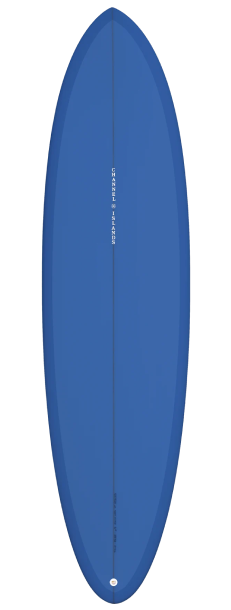
Trip Forman: Awesome, we’re excited to have you guys here. We’re talking about the Channel Islands Mid Twin. Devon has been a huge part of developing the entire mid-length range at Channel Islands. This came on the heels of the CI Mid, and this was the second board in that lineup, set up as a dedicated twin fin. Devon, take it away—tell us your thoughts when you came up with this design.
Devon Howard: When we worked on the Mid in 2018–2019, Torren Martyn was really gaining attention and people were questioning why we introduced a mid with a 2+1 setup. Twins were trending, so some thought the 2+1 seemed outdated. My feeling was I had spent decades riding 2+1s and knew them really well in terms of rocker and fin placement. I wanted proof of concept first—if people believed in that design, then we could move into a twin fin. I didn’t come from a twin background, so I didn’t want to put anything out that wasn’t legit.
The Mid did really well, and the 2+1 has a wide sweet spot. You can ride it forward, it’s versatile, and you can even run it as a single fin in small waves. Once we felt confident, I moved into a twin fin version, but it had to be dialed. We didn’t just throw twin fins on it—we went through iterations with fin placement.
What I noticed right away was the twin had more speed, especially down the line. In beach breaks where you need to get from point A to point B quickly, the twin is noticeably faster—more linear, drag-strip speed. The Mid is already fast, but this is even faster, especially with larger fins that have more base.
We developed the board with the Britt Merrick Twin (BMT), but because of my size—6’1”, around 195 lbs—I went to the AMK keel and loved it. Coming from San Diego, I was used to riding keels. With the added speed, I was able to size the board down a bit. I didn’t need as much rail length or surface area to generate speed, so I went an inch or two shorter. That balance of volume, speed, and planing is key.
On the Mid I was riding around 6’10” to 7’0”, and on the Mid Twin I was riding 6’11” and even down to 6’9”. Now I’m back to 6’11”, but it’s helpful for surfers to know you can size down slightly with the twin because of the extra speed.
One thing to understand is how to turn a twin. Your feet need to be more over the fins compared to a 2+1. With larger twin fins like the BMT or AMK, you need to be a bit more precise with foot placement. The sweet spot is slightly smaller, so you just need to be aware of where your feet are.
You also need space with a twin. Tight turns in small waves are harder on a mid-length twin because of the rail length. If your expectation is to do tight wrap turns, that’s not realistic. But if your goal is to get to your feet, go fast, and do floaters or re-entries, you can do that all day. This board really comes to life from shoulder-high to overhead waves.
The 2+1 has a tighter turning radius and works better in mushy waves when you want to stay near the whitewater. The twin is about speed and hold—it draws wider arcs, but if you have space, that’s perfect. These boards are about rail surfing, not tail surfing. If you try to surf them like a shortboard, you’re making it harder on yourself.
To get the most out of it, keep most of the board in the water and focus on rail-to-rail transitions, almost like powder snowboarding. If your waves don’t suit that style, the regular Mid might be a better choice because you can switch to a single fin and pivot more easily.
If you already have a small wave board and want something for medium to better waves, I’d go with the twin. I live near Rincon now and use the twin when it’s crowded and I want maximum speed. If you’re flying down the line, people are less likely to drop in.
For fins, I use the BMT in really small waves and the AMK when it’s armpit-high and above. I don’t use MR-style fins much—they feel too slidey to me, but lighter riders might like them.
Trip Forman: I appreciate your point about not surfing mid-lengths like shortboards. That’s where mid-length surfing can look bad. But when you watch someone surf these properly, it’s mesmerizing.
Devon Howard: Surfing is an art. Smooth, clean surfing translates to performance. If you watch closely, the rail engagement is critical. If you try to shortboard these designs, you’re actually hurting your performance because you’re breaking trim and not using the board as intended. The rocker is designed to be ridden more forward. Even with thrusters, I move the fin cluster forward to make it work better.
I’m really happy with the twin version. If you watch clips from Channel Islands, you’ll see how riders like Mikey February use the rail and maintain flow. The biggest difference between the boards is that wide-open speed.
Trip Forman: I think if you’re choosing between the two, it comes down to your waves. If you surf smaller, average waves, the CI Mid is great. But if your waves get better or you want more speed, go with the twin.
Devon Howard: Speed for the win.
Trip Forman: Awesome, Devon. Thanks so much for sharing your insight on the Channel Islands Mid Twin. If you have any questions or want to order one, you can reach us at the shop or online at realwatersports.com.